
How to Build a Strong Value Proposition for Your Construction Business
Why some builders and tradies win work without being the cheapest
Executive Summary
Most builders believe customers choose the lowest price. In reality, homeowners and commercial clients are looking for the business they trust to deliver the best overall outcome with the least risk. A strong value proposition explains why a client should choose your business instead of another builder or trades business. It isn’t a clever slogan or marketing catchphrase. It’s the combination of benefits, experience, proof and customer outcomes that makes your company the obvious choice.
After working with more than 100 construction businesses throughout New Zealand, I’ve found that the strongest value propositions are built on three foundations:
- Your service must solve a genuine customer problem, or help fulfil a want or dream.
- You must clearly explain why you’re different.
- You must provide convincing proof that you’ll deliver what you promise.
Businesses that consistently communicate these three elements typically attract better-quality enquiries, experience less price resistance and win more profitable work.
Key Takeaways
- Customers buy confidence before they buy construction services.
- A value proposition is much more than a slogan.
- Differentiation reduces price competition.
- Evidence builds trust.
- Every marketing message should reinforce your value proposition.
What Is a Value Proposition?
A value proposition is the collection of reasons a customer decides to buy from your business rather than someone else’s.
It’s the answer to one simple question:
“Why should I trust you with my project instead of another builder (or plumber or electrician, etc)?”
Many businesses think their value proposition is simply:
“Quality workmanship at competitive prices.”
The problem is that almost every construction company says exactly the same thing.
A genuine value proposition is demonstrated through your processes, communication, customer experience and proven results—not just your advertising.
The Three Foundations of a Powerful Value Proposition
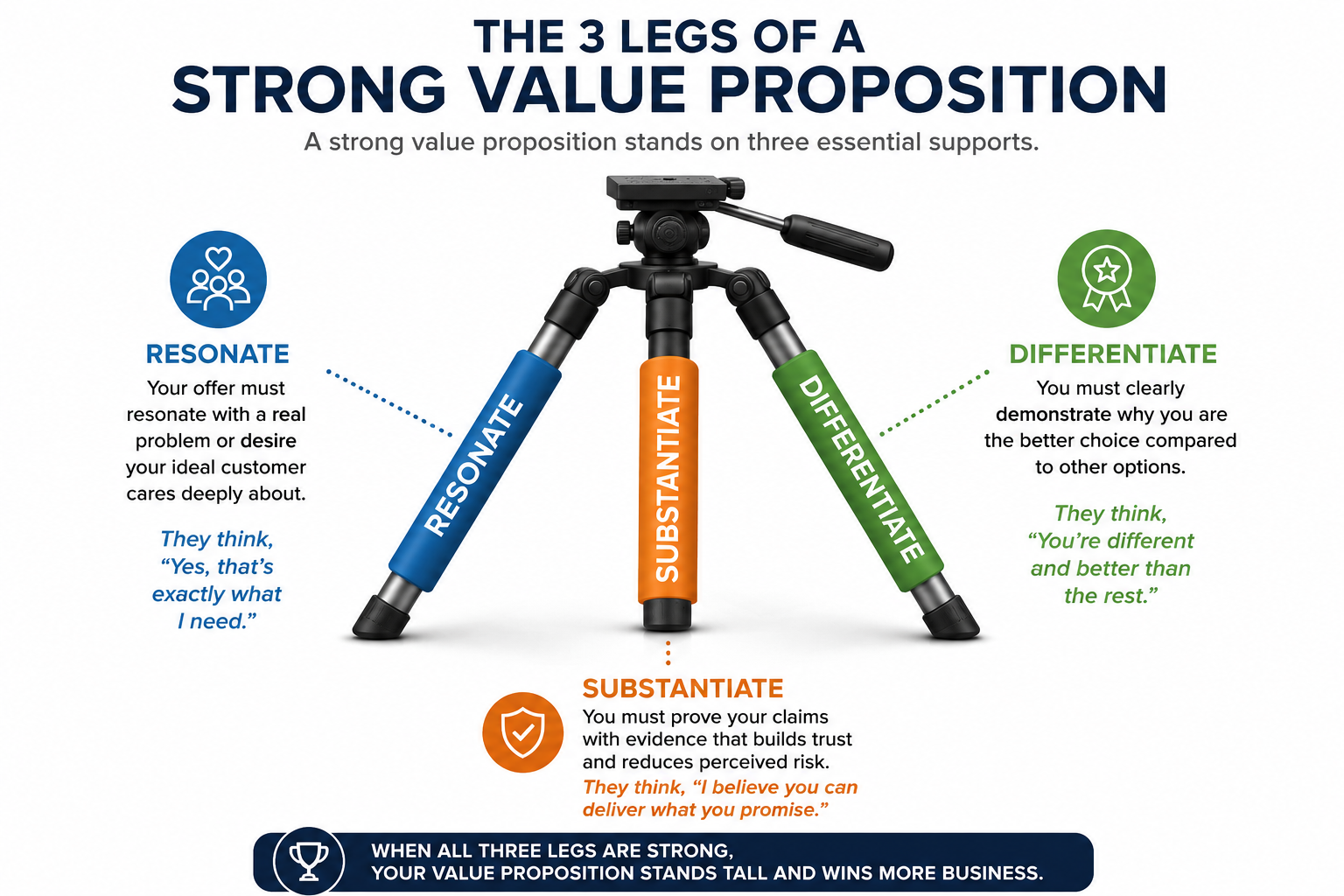
I like to think of these as the three legs of a tripod. Remove one leg and the whole structure becomes unstable.
1. Your Offer Must Resonate
Your ideal customer must immediately recognise that you solve a problem they genuinely care about.
For example:
- Removing the stress from renovating.
- Helping homeowners avoid costly mistakes.
- Delivering projects with complete price transparency.
- Creating warmer, healthier homes.
- Completing projects with minimal disruption.
If your message doesn’t address a real concern, people won’t engage.
2. You Must Differentiate Yourself
Once customers know you can help, they ask:
“Why should I choose you?”
This is where many tradies struggle.
Real differentiation rarely comes from claiming better workmanship.
Instead, think about differences such as:
- A documented project management system.
- Fixed communication milestones.
- Weekly client progress reports.
- Detailed pre-construction planning.
- Specialist expertise.
- Industry-specific guarantees.
- Educational resources for homeowners.
These are difficult for competitors to copy.
3. You Must Prove Your Claims
This is where trust is built.
Customers naturally ask:
“Can they actually deliver?”
Proof comes from evidence such as:
- Client testimonials.
- Google reviews.
- Before-and-after photography.
- Case studies.
- Awards.
- Years of experience.
- Detailed project schedules.
- Professional systems and documentation.
Every piece of evidence reduces perceived risk.
Why Most Builders Compete on Price
Many construction businesses accidentally remove the three strongest parts of their value proposition.
Instead of explaining:
- their process
- experience
- communication
- project management
- customer outcomes
they simply send a quotation.
The customer then compares one number against another.
When your value proposition disappears, price becomes the only comparison.
A Practical Exercise
Ask yourself these five questions.
- Why do our best customers choose us?
- What problems do we solve better than competitors?
- What do customers consistently thank us for?
- What evidence proves our claims?
- What would customers genuinely miss if we disappeared tomorrow?
Your answers become the foundation of your marketing.
Common Mistakes
Avoid these common value proposition mistakes:
- Competing only on price.
- Using generic statements like “quality workmanship”.
- Talking about your business instead of customer outcomes.
- Making claims without proof.
- Trying to appeal to everyone.
Frequently Asked Questions
What is the difference between a value proposition and a slogan?
A slogan is a short marketing phrase. A value proposition explains why customers should choose your business and is demonstrated through your service, processes and customer experience.
Can a small building or trades company have a strong value proposition?
Absolutely. Smaller businesses often compete successfully because they offer more personal service, better communication, specialist expertise or greater flexibility than larger competitors.
How often should I review my value proposition?
At least once a year, or whenever your target market, services or competitive landscape changes.
Is quality workmanship a value proposition?
Not on its own. Customers expect quality workmanship as a minimum standard. Your value proposition should explain what additional value, confidence or outcomes clients receive by choosing your business.
Final Thoughts
The best value propositions aren’t created by marketing agencies—they’re built into the way a business operates every day.
If your systems, communication and customer experience consistently deliver on your promises, your marketing becomes much easier because you’re simply telling the truth about how your business works.
You might also like to check out some related articles on marketing:
About the Author
Andy Burrows is the founder of Trades Coach and has spent more than a decade helping New Zealand builders and construction business owners improve profitability, strengthen their sales process and build businesses that are less dependent on the owner. His practical advice is based on working directly with more than 100 construction businesses across New Zealand.